
Review · FLORENCE
Private Guided Visit of Florence Santa Maria Novella Basilica and its Officina Profumo Farmaceutica
Santa Maria Novella gives you two very different Florence experiences in one compact visit: a major Dominican church filled with Renaissance art, followed by an old pharmacy where monks once made rose water, balms, and herbal remedies. Masaccio’s Trinity and the painted Green Cloister are the artistic stars, while the pharmacy adds an unusual, fragrant note to the morning.
I like the private format, since a guide can answer your questions and point out details that are easy to miss. I also like the mix of art and daily history, especially the connection between the Dominican friars’ gardens and today’s perfumes and soaps. The main concern is pace: some guides spend most of the hour on the basilica, leaving the pharmacy visit feeling brief.
Key points to know before booking
- Masaccio’s Trinity and Giotto’s Crucifix: Two major works give the church real artistic weight.
- Paolo Uccello’s Green Cloister: The green-earth frescoes create a quieter, more atmospheric stop.
- Private English tour: Only your group participates, with guides such as Andrea, Laura, and Marcello named in visitor feedback.
- A pharmacy with medieval roots: The Officina grew from Dominican plant cultivation, distillation, and herbal remedies.
- Extra cost at the door: The adult basilica ticket is €7.50, with reduced pricing for ages 11 to 17.
- Short but concentrated visit: Plan on about 60 minutes in the basilica and 30 minutes at the pharmacy.
Santa Maria Novella, Florence’s church of art and science
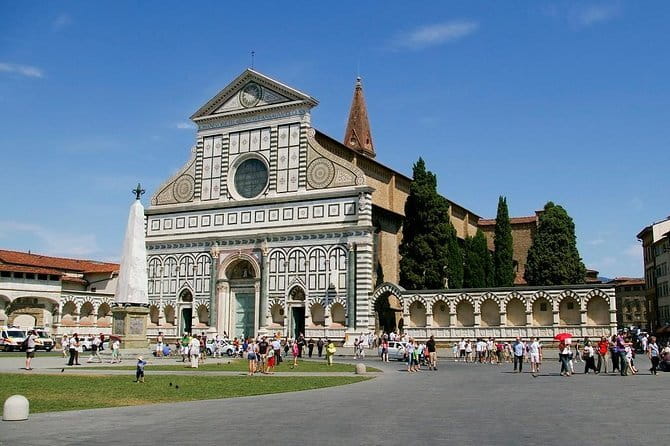
Begin outside the Basilica of Santa Maria Novella at Piazza di Santa Maria Novella, 18. The meeting point is easy to find, since the church faces the square with a striking facade of white and dark green marble. That facade is one of Florence’s clearest examples of Renaissance design, and it gives you a fine first look before you enter.
The church was founded by Dominican friars at the beginning of the 13th century. The Dominicans were a mendicant order, meaning they relied on preaching and public support rather than the large agricultural estates associated with some older monastic communities. Your guide explains how that role shaped the church’s place in Florentine life.
This background matters because Santa Maria Novella was not simply a quiet house of prayer. It was a center of preaching, learning, art, medicine, and public religious life. The church’s paintings were designed to teach as well as decorate, and a good guide helps you read the scenes rather than simply pass them by.
The visit lasts about an hour inside the basilica and adjoining cloister. That is enough time for a clear introduction to the major works, but not enough for every chapel and side detail. I would treat this as a focused first visit, not a complete study of the entire complex.
More Guided Tours in Florence:
- E-bike Tuscany and Chianti Self-Guided Tour with Vineyard Visit
★ 5.0 · 8 reviews - Mykonos: Farm, Ano Mera Village, and Beaches Guided Tour
★ 4.4 · 1,283 reviews - Lahaina: Maui Ku’ia Estate Guided Cacao Farm Tour and Tasting
★ 5.0 · 1,103 reviews
The masterpieces inside the basilica
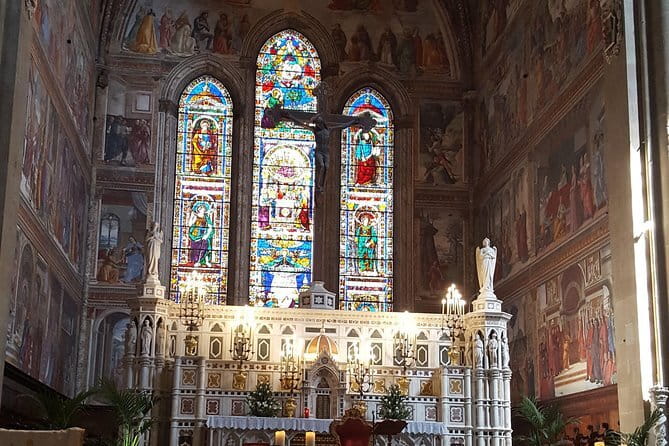
The first major work to look for is Giotto’s Crucifix. Giotto helped move Italian painting toward greater emotional force and more solid, human figures. The work is an important reminder that Florence’s artistic story began before the best-known Renaissance names.
Masaccio’s Trinity is another essential stop. The fresco is famous for its use of perspective, which creates the illusion of a chapel opening in the wall. Even if you are not an art specialist, the effect is easy to grasp when a guide directs your eyes to the architectural lines and the placement of the figures.
The church also contains major fresco cycles by Domenico Ghirlandaio and Filippino Lippi. Ghirlandaio’s work is especially valuable for its detailed scenes and the way it reflects the world of late 15th-century Florence. Filippino Lippi’s paintings add another layer, with their expressive figures and decorative detail.
One of the strongest parts of a private visit is the chance to stop and ask about a detail that catches your eye. Andrea was praised for answering questions and helping with photographs, while Laura helped one visitor locate Plautilla Nelli’s restored Last Supper. That work is not always the first thing people associate with Santa Maria Novella, so it is worth asking your guide if it can be included in the route and time allows.
The church also has connections to papal and Spanish influence, details that help explain why the complex feels broader than a single art museum. One visitor particularly appreciated seeing how Spanish influence appeared in parts of the church. Your guide can place those details in the larger story of Florence’s religious and political life.
The Green Cloister and Paolo Uccello’s painted world
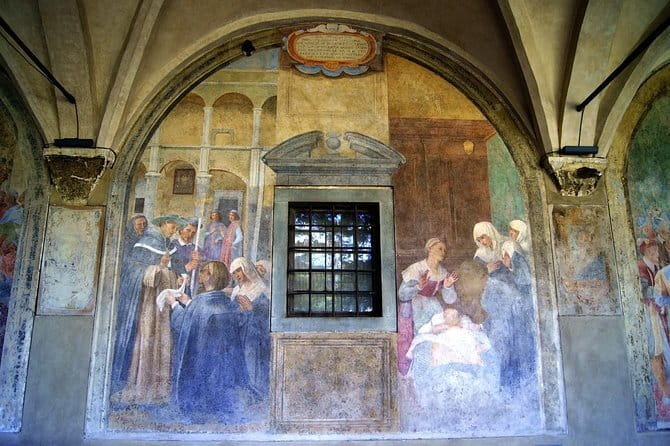
The tour ends in the Green Cloister, known for the green-earth tones used in its frescoes. Paolo Uccello’s paintings give this space a different mood from the grand church interior. The colors are subdued, the setting is calmer, and the cloister offers a welcome pause after the dense decoration of the basilica.
The frescoes are not simply pretty wall paintings. They show how cloisters helped turn religious stories into visual lessons for the friars who lived and worked nearby. The green tones also give the space its name and make it easy to recognize as a separate part of the complex.
I like this section because it slows the visit down. The basilica’s famous works can make you rush from one masterpiece to the next, while the cloister encourages you to look at the setting itself. It is also the point where the church’s architecture, religious life, and artistic program come together.
The timing here can vary. If your guide has spent extra time explaining the basilica, the Green Cloister may receive less attention than you expect. If this part matters to you, say so near the start of the visit. A private tour gives you a better chance of shaping the emphasis, though the 90-minute schedule still imposes limits.
From Dominican gardens to the Officina Profumo Farmaceutica
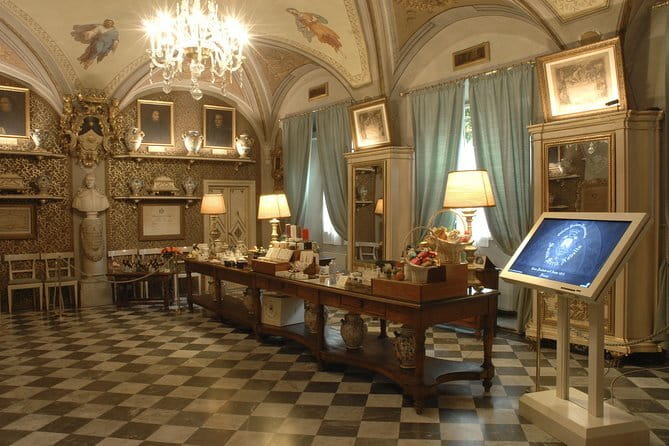
The second half takes you to the Officina Profumo Farmaceutica di Santa Maria Novella, commonly called the Santa Maria Novella Pharmacy. It occupies the original historic building connected with the old Dominican monastery. Inside, vaulted ceilings, wall frescoes, and the scent of soaps and perfumes create a sharp contrast with the church.
The pharmacy’s story reaches back to the 14th century, when Dominican monks sold rose water as a disinfectant, especially during epidemic periods. The monks cultivated plants on land behind the cloisters, then used herbs and flowers to prepare practical remedies.
During the 16th century, Cosimo I de’ Medici and later members of the Medici family took an active interest in natural science. The monks expanded their work by cultivating medicinal plants, distilling herbs and flowers, and producing essences, ointments, and balms. The present workshop dates to 1612.
That date gives the pharmacy much of its appeal. You are not just entering a modern perfume shop with an old-fashioned interior. You are seeing a commercial tradition that grew out of a religious community’s work with plants and medicine. The modern products include perfumes and soaps based on old recipes, so the space links historic practice with present-day retail.
Still, set your expectations carefully. The pharmacy is also a sales shop. You can admire the rooms and browse its products, but the experience is not presented as a full laboratory demonstration or a long apothecary lecture. One visitor found the pharmacy visit too rushed and wanted more explanation. Another considered it the highlight, while a Spanish-speaking visitor felt it was mainly a place to buy colognes and cosmetics.
Those different reactions point to the key question: what do you want from the pharmacy? If you enjoy old interiors, fragrance, religious history, and the story of traditional remedies, you will probably find the visit worthwhile. If you expect a working museum with an extensive explanation of ingredients and production, you may find the 30-minute stop thin.
Same countryside, another kind of harvest:
- Florence Pizza or Pasta Class with Gelato Making at a Tuscan Farm
★ 5.0 · 6,801 reviews - Cooking Class and Lunch at a Tuscan Farmhouse with Local Market Tour from Florence
★ 5.0 · 4,831 reviews - Florence: Pizza or Pasta Class with Gelato at a Tuscan Farm
★ 4.9 · 1,181 reviews - Florence: Cooking Class at a Tuscan Farm & Local Market Tour
★ 4.9 · 354 reviews
How the private guiding affects the experience
The tour is offered in English and is private, so only your group participates. That is the main reason to choose this option over simply visiting the church and pharmacy on your own. A private guide can adjust the explanation to your interests and respond to questions without a large group interrupting the flow.
The guides named in visitor feedback include Andrea, Laura, and Marcello. Andrea was praised for punctuality, attention to questions, and help with photographs. Laura received strong praise for bringing the church to life and helping locate Plautilla Nelli’s Last Supper. Marcello was considered strong on the basilica, but the pharmacy portion felt too short for one group.
That difference is useful to keep in mind. The quality of the visit depends not only on the buildings but also on how your guide divides the time. Tell the guide early if the pharmacy is a major reason you booked. If the basilica’s paintings are your priority, ask for extra context on Masaccio, Ghirlandaio, Filippino Lippi, or the Green Cloister.
Earphones are supplied for groups larger than seven participants. Since this is a private activity, that detail may not affect smaller parties, but it can help keep the explanation clear if your group is larger.
Is $124.96 a fair price?
At $124.96 per person, this is not a budget church visit. You also pay the basilica admission separately: €7.50 for adults, €5 for ages 11 to 17, and free for children aged 10 and under. The tour information says admission is not included, so check the exact payment process with the guide when you arrive.
The price makes more sense for couples, families, or small groups who value personal attention. If several people share the private booking, the cost per person may feel easier to justify, especially when you want a flexible explanation in English. A solo visitor pays the highest effective price but gets the most direct access to the guide.
You are paying for more than entry. The fee covers the guide’s time, the connection between the church and pharmacy, and the chance to ask questions throughout the visit. Still, the value depends on the pharmacy portion being handled well. If you mainly want to see the basilica’s art, a standard admission ticket and a good guidebook may cost much less. If you want both sites explained in one sitting, the private format has a clearer purpose.
The tour is often reserved around 40 days ahead, which suggests you should not leave it until the last minute if your Florence dates are fixed. It offers free cancellation if you cancel at least 24 hours before the start time. Changes or cancellations within 24 hours are not refunded.
Who should book this Florence visit?
I would recommend it to first-time Florence visitors who want a clear introduction to Santa Maria Novella without spending half a day on a large museum. It suits anyone curious about Renaissance painting, Dominican life, historic remedies, or the development of perfume making.
It is also a good match for families with mixed interests. One person can focus on Giotto and Masaccio, while another may prefer the pharmacy’s scents, products, and old rooms. The short format helps if you have other plans in Florence.
Art lovers should book it with a specific request list. Ask about Masaccio’s Trinity, Giotto’s Crucifix, Ghirlandaio, Filippino Lippi, Paolo Uccello, and Plautilla Nelli. Pharmacy enthusiasts should make clear that they want the full 30-minute section, not a quick walk through the shop.
I would think twice if you dislike retail spaces or expect a long technical explanation of perfume production. The pharmacy is historic, but it is also a functioning place of sale. You can admire the original building without needing to buy anything, but the visit naturally leads into displays of modern cosmetics and fragrances.
Should you book it?
Book this tour if you want a private, compact introduction to two unusual sides of Florence: the city’s great religious art and its old botanical and apothecary traditions. The basilica is the stronger anchor, with Masaccio, Giotto, Ghirlandaio, Filippino Lippi, and the Green Cloister giving the visit real substance.
The pharmacy is the deciding factor. It can be the most memorable part if you like historic interiors and old remedies, but it may feel brief if your guide focuses heavily on the church. At the start, ask for a balanced split and mention any specific artwork or pharmacy question you care about.
For a first visit to Santa Maria Novella, I find the combination worthwhile. Just remember that you are buying a guided introduction, not an all-day art course or a behind-the-scenes perfume workshop.
FAQ
How long does the Santa Maria Novella tour last?
The experience lasts about 1 hour and 30 minutes. The planned visit includes about one hour at the basilica and Green Cloister, followed by about 30 minutes at the Officina Profumo Farmaceutica.
What is included in the tour price?
A local professional guide is included. Earphones are supplied for groups of more than seven participants.
Is the basilica admission included?
No. The basilica admission ticket is paid separately. The stated prices are €7.50 for adults, €5 for ages 11 to 17, and free for children aged 10 and under.
Is this a private tour?
Yes. Only your group participates in the activity.
What language is the tour offered in?
The tour is offered in English.
Can I cancel for a full refund?
Yes, if you cancel at least 24 hours before the experience starts. Cancellations made less than 24 hours before the start time are not refunded, and changes within that period are not accepted.
Newly listed farm visits around Florence
- PRIVATE TOUR: Chianti Afternoon tour with visit to 2 wine farms★ 5.0 · 9 reviews
- My Tuscan Farm – Three Experiences in One Day★ 5.0 · 62 reviews
- San Gimignano and Vernaccia Wine Tour with Lunch at Farm★ 5.0 · 2 reviews
- Florence: San Lorenzo Farmers Market Food Tour with Wine Tasting in 4 hours★ 5.0 · 2 reviews
- Horse ride, Olive Oil and local foods tasting in a Tuscan farm★ 5.0 · 19 reviews
- Vintage Fiat 500 Wine Tour and Tuscan Lunch at Farm in Chianti★ 5.0 · 20 reviews
- E-bike Chianti Classico & Tuscany tour with Wine & Lunch at Farm★ 5.0 · 38 reviews
- E-bike Tuscany and Chianti Self-Guided Tour with Vineyard Visit★ 5.0 · 8 reviews
Florence Farm Tours, compared.

Florence Pizza or Pasta Class with Gelato Making at a Tuscan Farm
Read our review →
Cooking Class and Lunch at a Tuscan Farmhouse with Local Market Tour from Florence
Read our review →
Cooking Class at a Tuscan Farm & Local Market Tour
Read our review →
Florence Sunset Food Tour with Wine & Dine at a Tuscan farmhouse
Read our review →
Experience Chianti & Cheese w/ 3 wineries & dairy visit—max 8 pp
Read our review →
Farm To table Experience on an organic hilltop estate in Tuscany
Read our review →
It’s Wine Time! 2 wineries & farm-to-table lunch—max 8 pp
Read our review →
Fiesole: Tuscan Countryside Half Day E-Bike Tour & Farm visit
Read our review →Browse the lists this tour appears in